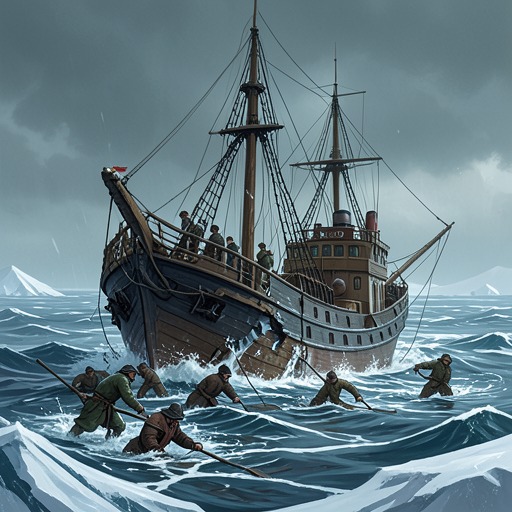
Brownlee and Baxter's secret profit scheme
The North WaterBrownlee and Baxter’s secret profit scheme redirects the Volunteer from the business of whaling toward a planned, insured loss. As the Greenland fishery becomes harder and more expensive, Baxter presents a three-way division of £12,000 as a better prospect than the uncertain proceeds of a successful season. Brownlee’s agreement is reluctant and conditional: the ship must be lost in a way that will withstand scrutiny, and the money—not the whales—is the venture’s real purpose.
Economic Pressure and the Promise of Money
Baxter frames the scheme against a changing industry. Brownlee recalls that decades earlier a modest vessel and harpoon could bring wealth; now, he argues, success depends on costly steam power, harpoon guns, and luck, and a ship may return without a catch. Brownlee rejects the idea that the trade is finished, insisting that petroleum is only a passing fashion and that whales remain available to a capable captain. His confidence in his skill, however, sits beside the practical weakness Baxter exploits: the old route to profit has become far less dependable.
Baxter makes the alternative concrete by producing two sheets of parchment and emphasizing that £12,000 divided three ways is a substantial sum, beyond what Brownlee could reasonably expect to earn from killing whales. Brownlee acknowledges the calculation but does not treat it as a simple windfall. His response that this is what matters now carries the weight of a compromise: the voyage still has the outward purpose of a whaling expedition, but its central financial logic has shifted to a different outcome.
The scheme also gives money an almost independent force in Baxter’s explanation. He describes it as something that finds a new route when one passage is blocked, beyond the control of the men who serve it. The metaphor makes their choice sound both calculating and constrained: Baxter and Brownlee pursue the profit, yet Baxter presents the pursuit as a pressure that dictates their decisions. Brownlee’s warning that there must be enough ice, and Baxter’s assurance that there is always ice, connect the abstract promise of money to the material conditions of the Arctic voyage.
Participants and Conditions
The plan depends on a third participant, Campbell. Brownlee makes his presence a condition of continuing: if Campbell is not there when needed, Brownlee will turn the ship around and sail home. Baxter assures him that Campbell will appear and has reason to cooperate, since success would put him next in line. The exchange establishes a chain of mutual expectation rather than a scheme Brownlee can carry out alone. Brownlee needs Campbell at the crucial moment; Baxter relies on Brownlee’s command of the Volunteer and on a rendezvous that makes the intended loss possible.
The arrangement is concealed from the rest of the crew. In conversation with Baxter, Brownlee insists that the secret is shared only between them. That secrecy matters because the ordinary work of the voyage must continue around the hidden purpose. The ship sails north from Lerwick through difficult weather, and the crew begins by hunting seals. Brownlee counts the skins and estimates their commercial value, while the men work through the physically demanding stages of killing, skinning, hauling, and loading. These are real operations, not merely a verbal pretext: the expedition produces cargo and proceeds as a working whaling voyage, even as the men directing it anticipate a larger return from the ship’s loss.
Whaling as Cover and the Need for a Credible Loss
The catch gives the Volunteer an apparent commercial purpose. After the sealing, the crew’s morale improves, and the ship continues north. In the North Water, Black strikes the first whale; Otto’s boat and the other whaleboats join the hunt, and the crew kills and flenses the animal. Brownlee estimates that it will yield ten tons of oil and at least half a ton of whalebone, worth close to £900 at market if prices hold. He shares the prospect of wealth with Sumner, while the crew receives an extra ration of rum after the labor is done. Such details show how the visible economy of the voyage is sustained: whales are hunted, valued, processed, and stored, even though Brownlee and Baxter have already defined the fish as secondary to their larger financial purpose.
The planned loss must not look too deliberate. Campbell warns that the way the sinking appears is what matters, because an obvious arrangement would prompt questions from the underwriters. He also stresses the danger of delay: he might be trapped by the ice himself if they wait too long. Brownlee answers that the season’s ice should make the operation manageable. The plot therefore relies not only on an insured ship but on timing and a convincing maritime explanation for its disappearance. The ice is at once a real hazard of navigation and a condition the conspirators intend to use.
The threat is made more immediate when the wind shifts and drift ice begins moving toward the Volunteer. Cavendish orders the crew to cut an ice dock for protection. The work is substantial: men use saws, ropes, pulleys, and a fourteen-foot steel ice saw to cut through six feet of ice, forming a dock with sides two hundred feet long. The practical danger is plain, but the episode also sharpens the scheme’s concern with appearances. Cavendish observes that if the ship does not sink then, it can be sunk later, though doing so after the dock has been built would look less convincing. In this exchange, the dock becomes more than an emergency measure: it is part of the circumstances against which the intended loss will be judged.
Exposure and Consequences
The scheme’s successful completion is not presented as a clean, private transaction. Later, Sumner reconstructs the plot aloud to Baxter: he says that Baxter had Cavendish sink the Volunteer, while Drax and Sumner were the only men who might have known or suspected what had happened. In the intended arrangement, Drax would shoot Sumner and Stevens would then shoot Drax, leaving a tidy explanation and no surviving witnesses to the plan. Sumner concludes that the sequence misfired. His account identifies the intended sinking as part of a broader effort to control what the surviving men could reveal, not simply a means of collecting money from a lost ship.
Baxter does not accept Sumner’s account as stated. He praises the reasoning but calls it wrong, then turns attention to the two dead men in the timber yard and Sumner’s responsibility for one of their deaths, arguing that Sumner needs his assistance. The exchange leaves Baxter using the immediate danger of criminal accusation to regain leverage, even as Sumner has named the conspiracy. The profit scheme thus produces consequences beyond its expected division of money: it entangles the planned loss of the Volunteer with violence, attempted concealment, and a later struggle over which account of events will prevail.
The plan’s significance lies in the collision between ordinary maritime labor and deliberate commercial deception. Brownlee’s crew genuinely hunts and processes animals, and the ship genuinely faces dangerous ice; those visible facts give the concealed operation its plausible setting. Yet Brownlee’s insistence on Campbell’s presence, Baxter’s calculation of the three-way sum, and the repeated attention to what underwriters might suspect reveal a voyage organized around a fabricated accident. The Arctic’s hazards are not invented by the conspirators, but the scheme seeks to turn them into a financial instrument and a cover story.